
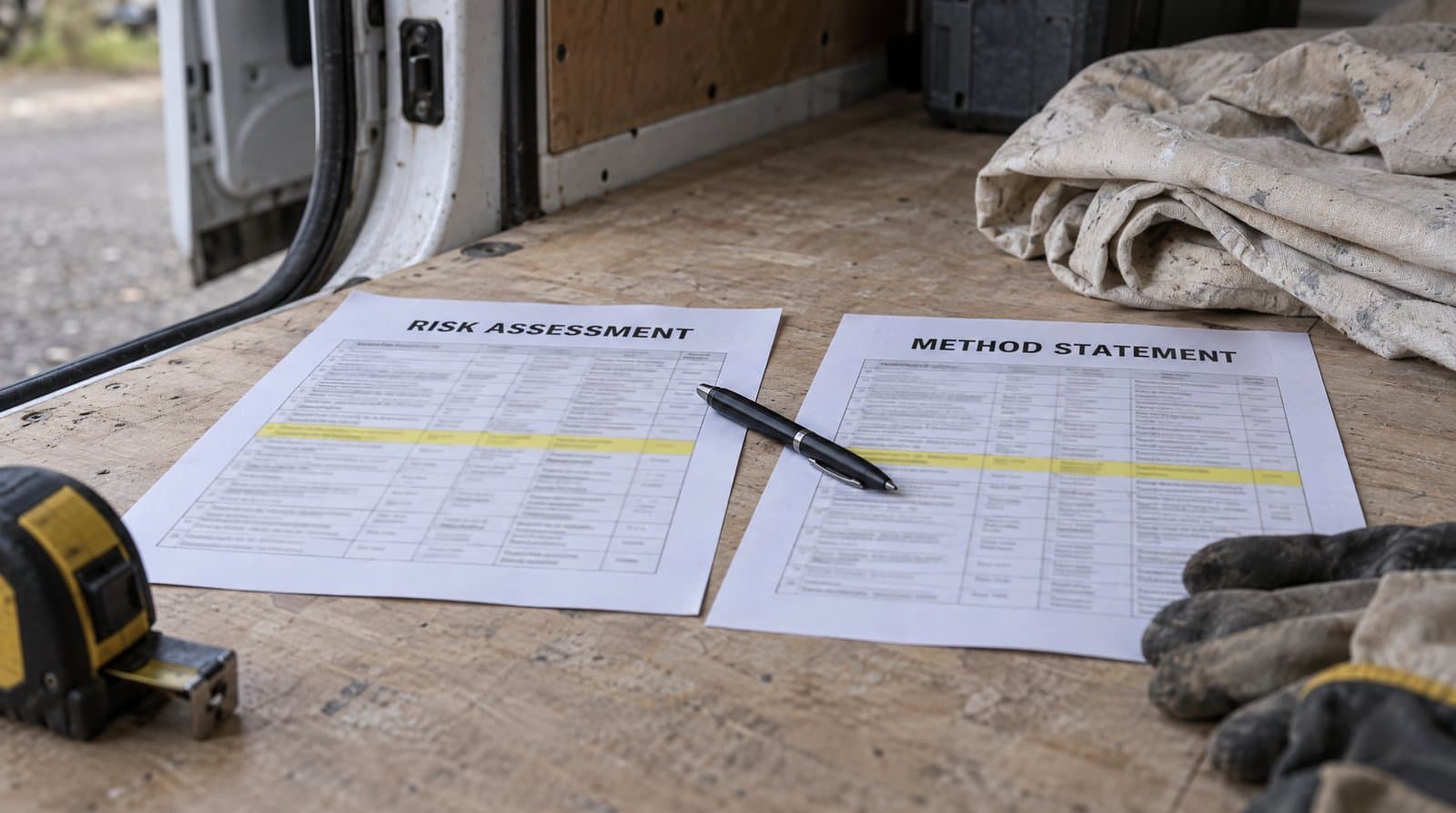
RAMS is a risk assessment and a method statement together, so a risk assessment on its own is only half of it. The risk assessment sets out what could harm someone on a job and how it will be controlled. The method statement sets out how the work will be done, step by step, with those controls built in. The law requires the risk assessment. The method statement is usually a client or contract requirement.
The question tends to come with a deadline: a request for RAMS when you have a risk assessment, or for both when you are not sure they have to match.
For the pack as a whole, see what a RAMS document is. For the first half, see how to write a risk assessment.
Risk Assessment vs Method Statement, Side by Side
| Compared on | Risk assessment | Method statement |
|---|---|---|
| The question it answers | What could go wrong, who could be harmed, and what will control it? | How will the work be done, in what order, and where does it stop for a check? |
| Who writes it | A competent person who knows the job. | The person who will run the work. |
| When | First, before work starts. Reviewed when something significant changes. | Second, built from the risk assessment. Revised when the method, people, equipment or site change. |
| Legal basis | Required by regulation 3 of the Management of Health and Safety at Work Regulations 1999. | No regulation names it. For most construction work HSE says it is not required by law. Often a contract condition. |
| What it contains | Hazards, who is at risk, controls, scores, further actions, review date, sign-off. | Numbered steps, hold points where work stops for a check, who does what, plant, emergency arrangements, briefing record. |
| Who reads it | The employer, client, principal contractor or inspector, to judge the thinking. | The people doing the work, and the reviewer who decides whether you start. |
That is the difference between a risk assessment and a method statement, row by row. The risk assessment decides the controls. The method statement says when each happens and who checks it.
Where One Ends and the Other Begins
The Order Test
A rule of thumb, not a legal test, settles most lines that could sit in either document. If a line would be true whichever order the work is done in, it belongs in the risk assessment. If it only makes sense at one point in the job, it belongs in the method statement.
On a tower job, "A fall from the tower could be fatal" is true before the tower goes up and after it comes down. That is risk assessment. "The supervisor inspects the tower before anyone climbs" only makes sense between building the tower and using it. That is method statement.
Which comes first is a separate question, and HSE answers it. It describes a method statement as drawing together the hazards and their controls "from the conclusions of the risk assessments". So the risk assessment comes first. No regulation sets that order.
When One Table Does Both Jobs
Some layouts put the hazard, the control and the step on one row. That works if the row still shows who could be harmed and how, how the risk was judged, and where the step falls in the order of work. Drop the scores or the order, and one job is not done.
No regulation sets a format, and HSE offers its template and examples as a guide. If the client has its own form, use that.
One Hazard, Two Documents
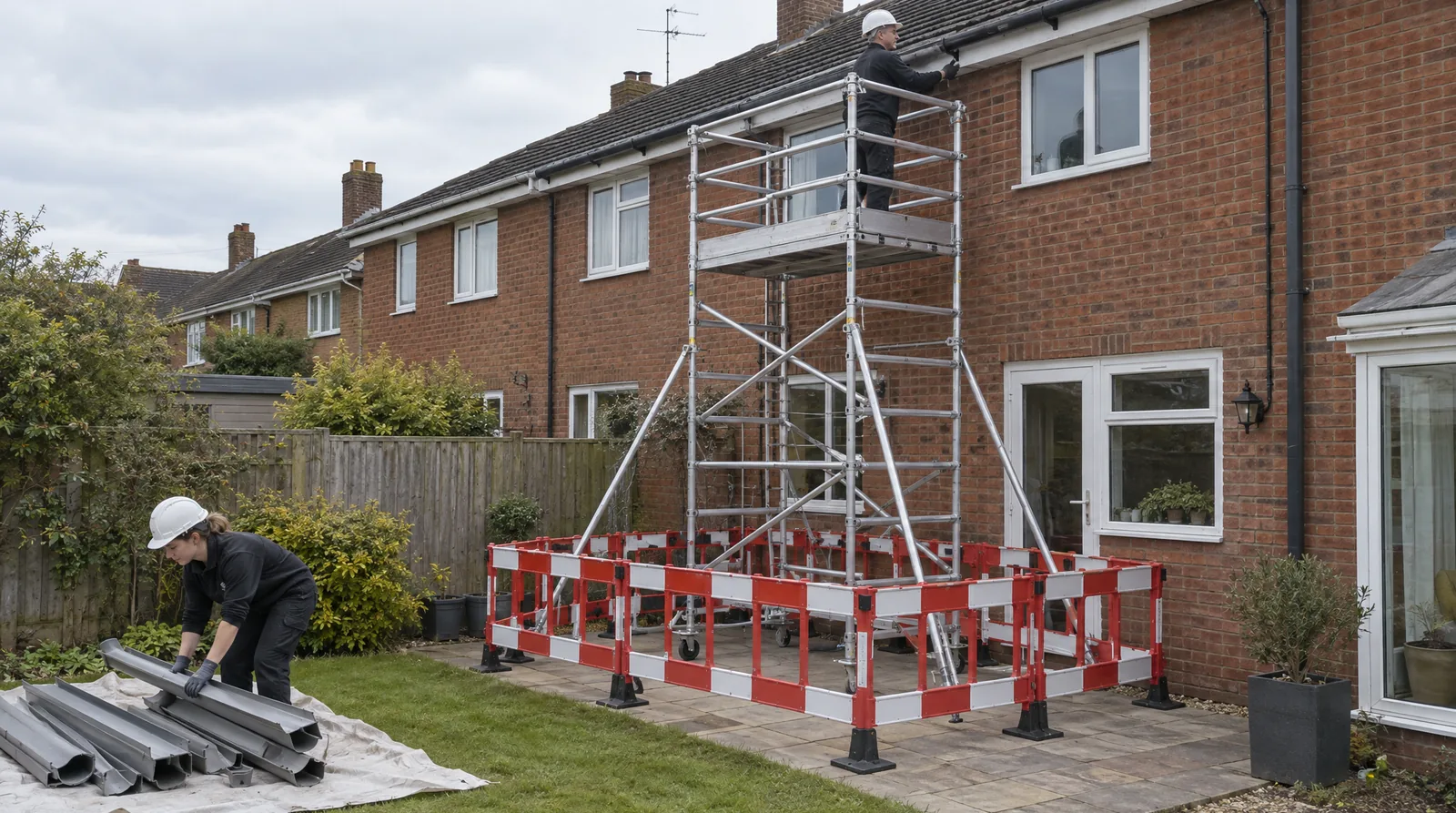
The example: a two-person firm, one of them the supervisor, replacing the rear fascias and gutters of a two-storey terraced house from a mobile tower in the back garden. The householder is at home. The scores are illustrative.
In the Risk Assessment
Line 1 is in full. Lines 2 to 4 show only their band and controls.
- Fall from the tower while working at eaves height. Who and how: both workers, by falling from the platform, or when the tower moves or tips with someone on it. Score as found: likelihood 3 x severity 5 = 15, High. Controls, most effective first: eliminate, not practicable at eaves height. Substitute, a guardrailed tower instead of ladders. Engineering, the tower built to the manufacturer's instructions on firm, level ground, with guardrails and toe boards fitted. Working method, built and inspected by trained people, and nobody on it while it moves. Residual: likelihood 1 x severity 5 = 5, held at High because the outcome is fatal. The guide explains how the 5 x 5 scoring works.
- Objects dropped on people below. Band after controls: High, because a falling length of gutter could kill. Controls: exclusion zone below the work, checked closed before work starts and after every tower move. Materials lowered by rope, nothing loose on the platform.
- The householder tripping over tools or materials. Band after controls: Low. Controls: garden kept clear of tools, householder told which door to use.
- Asbestos in old soffits, fascias or gutters. Band after controls: High, because breathing the fibres can be fatal. Controls: look before anything is stripped. If asbestos is suspected, stop and have it identified first.
HSE's diagrams of where asbestos can occur in a house built or refurbished before 2000 include soffits, fascias and gutters.
In the Method Statement
An excerpt. Each step ends with the risk assessment lines it serves.
- Walk the rear elevation with the householder. Hold point: the supervisor looks at the old soffits, fascias and gutters for asbestos. If anything is suspected, nothing is stripped until it is identified. (RA 4)
- Check the ground for the tower, set out the exclusion zone and tell the householder which door to use. Hold point: the supervisor confirms the ground is firm and level and the zone is closed, or the job is re-planned. (RA 1, RA 2, RA 3)
- Assemble the tower with two trained people, to the manufacturer's instructions, with guardrails in place before each level is climbed. Hold point: the supervisor inspects the finished tower before anyone climbs. (RA 1)
- Strip the old fascias and gutters from the platform. Lower materials by rope, never carry them down the tower. (RA 1, RA 2)
- Move the tower only when nobody is on it and the platform is clear. Hold point: after each move, the supervisor checks the zone is closed again before anyone climbs. (RA 1, RA 2)
- At the end of each day, clear the platform and garden, and tell the householder what is still out of bounds. (RA 2, RA 3)
What Changed on the Way
In the risk assessment each control was a decision. In the method statement it has a step, a person responsible and, for a High risk, a hold point.
| Risk assessment line | Steps | Hold point | Person responsible |
|---|---|---|---|
| RA 1: fall from the tower, High | 2 to 5 | Step 2: ground firm and level. Step 3: tower inspected. | Supervisor |
| RA 2: dropped objects, High | 2, 4, 5 and 6 | Steps 2 and 5: zone checked closed. | Supervisor |
| RA 3: householder trips, Low | 2 and 6 | None | Either worker |
| RA 4: asbestos in old boards, High | 1 | Step 1: nothing stripped until identified. | Supervisor |
Which Document Does the Law Require?
The risk assessment is required. Regulation 3 of the Management of Health and Safety at Work Regulations 1999 requires every employer to make "a suitable and sufficient assessment" of the risks to employees and others affected by the work. Regulation 3(2) puts the same duty on a self-employed person whose work is in construction or could put others at risk. Employers with five or more employees must record the significant findings.
No regulation names a method statement. For most construction work, HSE's guidance says method statements are "not required by law". The RAMS guide covers whether RAMS are a legal requirement under the construction regulations more widely.
The law comes closest for demolition and dismantling. Regulation 20(2) of the Construction (Design and Management) Regulations 2015 requires the arrangements for demolition or dismantling to be recorded in writing before that work begins. HSE says this is usually done with a method statement, though the regulation does not name one.
The expectation comes from the contract. A principal contractor must plan, manage and monitor the construction phase under regulation 13(1) of CDM 2015, and many ask each contractor for a method statement as part of that. This is practice, not law.
These regulations apply in Great Britain. Northern Ireland has its own: the Management of Health and Safety at Work Regulations (Northern Ireland) 2000 and CDM (Northern Ireland) 2016.
What to Send When You Are Asked
Send what the words ask for, and ask when the words are new to you.
| If the request says | Send | Why |
|---|---|---|
| RAMS | Both documents, for the same job, with the same date and version. | RAMS is the pair. The RAMS guide sets out what reviewers look for in the pack. |
| A risk assessment | The risk assessment. For construction work under a principal contractor, or work in an occupied building, ask whether a method statement is wanted too. | Wording varies. Asking can save a submission coming back. |
| A method statement | The method statement, with the risk assessment it was built from. | The reviewer will want to see where the controls came from. |
| A name you do not recognise, such as a client's own form | Nothing yet. Ask which documents they mean, and whether they have a template. | Do not assume it is a method statement by another name. |
Mistakes That Come From Mixing Them Up
- A risk assessment that is only steps. Numbered steps with "take care" notes, nobody named at risk and no scores. That is a method statement with the wrong title.
- A method statement that is only hazards. "Hazard: fall" inside step 3, unscored. The reviewer cannot see the judgement behind the controls.
- Controls copied into the steps. "Barriers in place" as a step, with no person and no check. Nobody owns it.
Check the Two Against Each Other
Before you send the pair, run three checks.
- Forward trace. Every High risk in the risk assessment has a step, a person responsible and a hold point in the method statement.
- Reverse trace. Every hold point in the method statement has an assessment line behind it. A hold point without one is padding, and it hides the ones that matter.
- Same job. The same site, people, equipment, dates and version number on both. Not ladders in one and a tower in the other.
If you would rather answer a short set of plain questions about the job than start from a blank page, Safetyfox writes the risk assessment or the method statement from your answers, one document at a time, for you to read and change before you use it.
Frequently asked questions
Is RAMS the same as a risk assessment?
No. RAMS is the risk assessment and the method statement together, so a risk assessment is only half of it. If you are asked for RAMS, send both, matched to each other.
Which comes first, the risk assessment or the method statement?
The risk assessment. HSE describes a method statement as drawing together the hazards and their controls "from the conclusions of the risk assessments". Build the sequence from the controls you chose.
Can a risk assessment and a method statement be one document?
Yes, if it does both jobs: who could be harmed, how the risk was judged, and the order of work with its checks. Many clients still want two documents, so check the request.
Is a method statement a legal requirement?
In Great Britain no regulation names one, and HSE says that for most construction work it is not required by law. Demolition or dismantling arrangements must still be recorded in writing. Clients often make one a condition of the job.
Can a method statement replace a risk assessment?
No. The risk assessment is the legal duty, under regulation 3 of the Management of Health and Safety at Work Regulations 1999. A method statement alone shows how you will work, not why.