
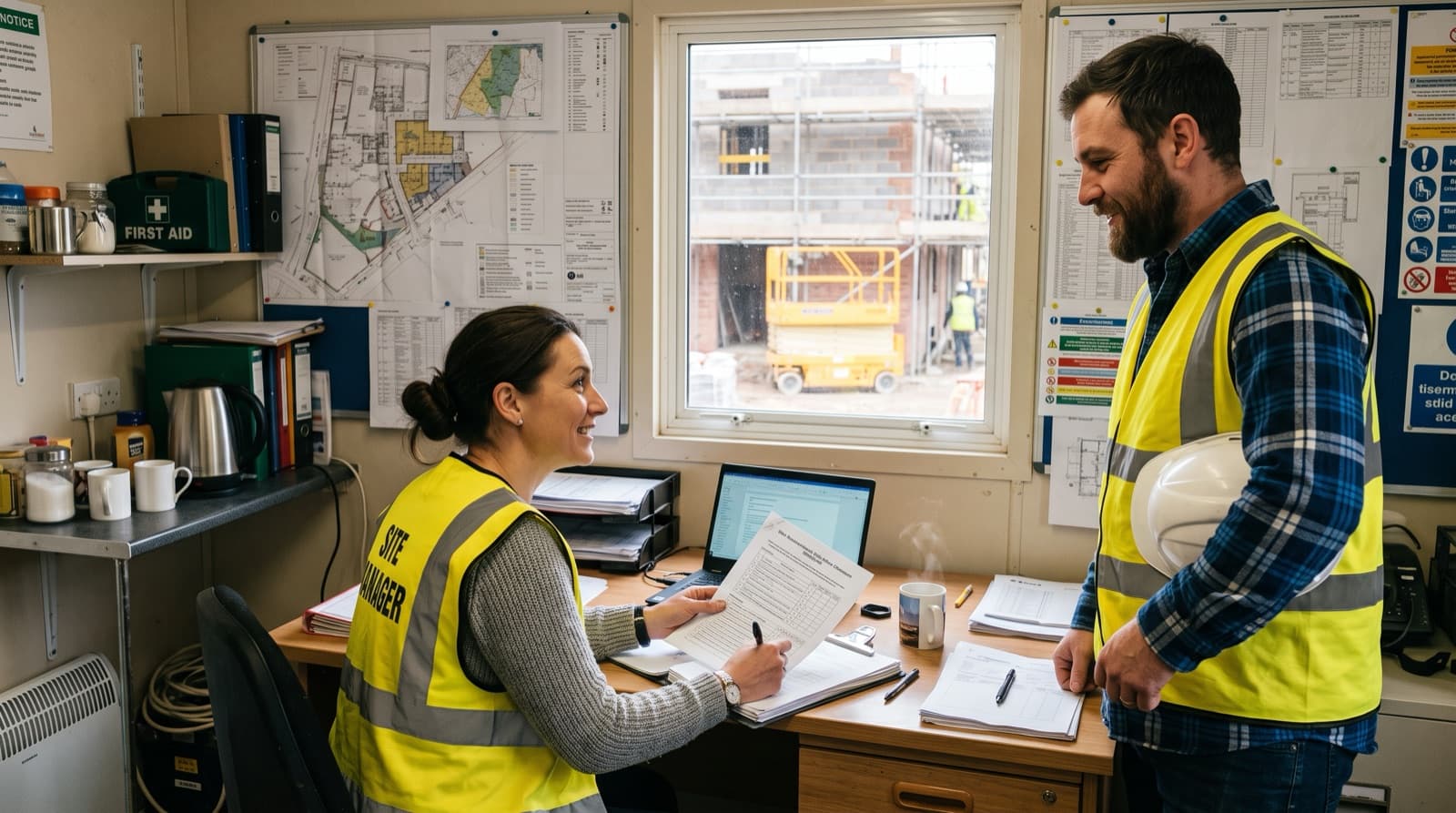
The first time most tradespeople hear the word is in an email. "Please send your RAMS before Monday." No explanation, because the person sending it has asked for RAMS a hundred times and assumes you have too. This guide is the explanation: what RAMS stands for, what each half does, whether the law actually requires it, who asks for it and what they are checking, and what a pack looks like when it gets accepted first time.
What Does RAMS Stand For?
RAMS is short for risk assessment and method statement. It is one pack made of two documents that are written together and read together. In construction it is the standard way a contractor shows a principal contractor how a job will be done safely. The same pack is asked for well beyond construction: by facilities managers before a contractor works in an occupied building, by venues and production companies before a build day, by schools, hospitals and housing associations before anyone starts on their premises.
Where hazardous substances are involved, a COSHH assessment usually travels with the pack as a third part. Most people still call the whole thing RAMS.
Risk Assessment vs Method Statement: What Each One Does
The risk assessment answers what could go wrong. It lists the hazards of the job, who could be harmed and how, scores how likely and how serious the harm would be, and sets out the controls that bring the risk down. It is the analysis.
The method statement answers how the job will be done. It describes the work as a sequence, in the order it will happen, with the controls from the risk assessment built into the steps, the points where work stops for a check, the people and equipment involved, and what happens in an emergency. It is the plan.
The two depend on each other. A method statement that never refers to its risk assessment is a list of good intentions. A risk assessment with no method statement leaves the reader to guess how the controls will actually be applied on the day. If you are writing the first half, our step-by-step guide to how to write a risk assessment covers it in detail.
Is RAMS the Same as a Risk Assessment?
No, though the words get used loosely. A risk assessment is one half of a RAMS pack. When a principal contractor asks for RAMS they want both halves, and sending a risk assessment on its own is one of the most common reasons a submission comes straight back.
Are RAMS a Legal Requirement in the UK?
Half of the pack is, directly. The other half is required in effect. It is worth being precise, because both the people who say "RAMS are the law" and the people who say "RAMS are just paperwork the PC wants" are wrong.
The risk assessment is a legal requirement. Regulation 3 of the Management of Health and Safety at Work Regulations 1999 requires every employer and every self-employed person to make a suitable and sufficient assessment of the risks arising from their work. That applies to a sole trader on a half-day job as much as to a main contractor. Employers with five or more people must record the significant findings.
No regulation names a method statement. You will not find the phrase in the Health and Safety at Work Act or in CDM. What the law does require, under regulation 15(2) of the Construction (Design and Management) Regulations 2015, is that every contractor plans, manages and monitors the construction work under their control so that it is carried out without risks to health and safety, so far as is reasonably practicable. If you are the only contractor on a project, regulation 15(5) requires you to draw up a construction phase plan before setting up the site. Where there is more than one contractor, the principal contractor holds the plan and checks each contractor's arrangements against it.
A method statement is how the industry has chosen to show that planning was done. It is the evidence, not the duty. That is why a principal contractor treats it as non-negotiable: they cannot let you on site without being able to show they checked how you intend to work, and your method statement is what they check.
So the honest answer is this. You must have a risk assessment. You must have planned the work. The method statement is the accepted way to prove both, and on any site with a principal contractor, or in any occupied building with a facilities manager, you will not be allowed to start without one.
Do I Need RAMS for a Small Job?
You always need the risk assessment, whatever the size of the job. Whether you need a method statement depends on two things: the risk of the work, and who is asking.
Write one when the work involves height, live electrical work, hot works, lifting, excavation, confined spaces, or the public and occupants moving around you. Write one whenever the client, the principal contractor or the building's manager asks for RAMS, because at that point it is a condition of the job. A low-risk half-day job for a private householder with nobody asking may need only a one-page risk assessment. Scale the paperwork to the risk and to the request, never to the invoice.
Who Asks for RAMS, and What They Check
The person reading your pack is usually a site manager, a facilities or estates manager, a production manager, or the compliance lead at a main contractor. They read dozens of these. They are not reading for style. They are checking a list, and it is nearly always the same list:
- Is it site-specific? The address, the dates, the client and the named people on the job. A pack with none of these could be for anyone, and is treated as if it were.
- Do the hazards match the job? Hazards that belong to a different trade, or that are missing for this one, tell the reader the document was not written for this work.
- Are the controls real, and in the right order? Eliminate, substitute, engineer out, then working method, then PPE. A pack whose every control is "wear PPE" has skipped the four steps that matter.
- Is there a sequence with hold points? Numbered steps in the order they happen, and named points where the work stops for a check: before isolation is trusted, before a load is lifted, before a corridor reopens.
- Who is doing the work, and are they competent? Names, roles, the cards and training the task needs. The reviewer checks this against the work described.
- What happens when something goes wrong? First aider, nearest A and E, fire arrangements, and a rescue plan for the specific thing that could go wrong on this job.
- Do the two halves agree? Every High risk in the assessment should appear in the sequence as a control or a hold point. If the method statement never mentions the risk assessment, the pack goes back.
- Is it signed, dated and current? Who wrote it, who approved it, which version this is, and a briefing record showing the people doing the work have read it.
What a RAMS Document Looks Like, Section by Section
There is no statutory layout. What follows is the order reviewers expect, because it is the order the thinking happens in. A straightforward job fits it in four to six pages.
- Project and contractor details. Client, site address, description of the work, start and finish dates, your company, the supervisor on site and a mobile number.
- Scope, including what is excluded. What this pack covers and what it does not. The exclusions are what stop it being reused on a job it was never written for.
- Risk assessment: hazards, who is at risk and how. One hazard per line, specific to this site, with the people and the mechanism of harm named.
- Risk assessment: controls and scores. Controls in hierarchy order, a likelihood and severity score before and after controls, and a further-action column with an owner and a date.
- People and competence. How many, in what roles, holding which cards and training. Include supervision arrangements and who has authority to stop the work.
- Sequence of work with hold points. Numbered steps from arrival to handover. Each hold point says what is checked, by whom, and what has to be true before work continues.
- Plant, equipment and PPE. What is being used, how it is inspected before use, and the PPE each step requires, with the standard it meets.
- Substances. Anything hazardous to health, with a COSHH assessment attached or referenced. Include the dust and fume the work creates, not only what comes in a tin.
- Emergency arrangements. First aider, first aid kit location, nearest A and E, fire and evacuation arrangements for this site, and the rescue plan for the highest risk in the pack.
- Sign-off and briefing register. Author, approver, version and date, and space for everyone doing the work to sign that they have been briefed.
Who Writes RAMS?
A competent person who understands the job. On most trade jobs that is the tradesperson or the supervisor who will lead the work, because they are the only person who knows how it will actually be done on the day. A consultant can write RAMS for you, and for unusual or high-risk work a specialist's input is worth having. But a consultant who has not seen the site produces a generic pack, and generic packs are what get rejected.
Whoever writes it, the person who signs the sequence should be the person who will run it. Responsibility does not transfer with the document. If an inspector or a client questions the assessment, the answer comes from the person who made it, not from whoever typed it up.
How Long Does a RAMS Pack Take to Write?
From a blank page, an evening. The risk assessment takes an hour or two if you walk the job properly. The method statement takes longer, because the sequence has to be thought through step by step and the hold points placed where they belong. Then the two have to be checked against each other.
The two shortcuts both have a cost. A downloaded template is quick, but it arrives with someone else's hazards and no sequence, and the time saved is spent again when it comes back. A consultant removes the work from your evening, at a cost of several days and often a few hundred pounds per pack, for a document written without having seen the job. Safetyfox sits between the two: you answer a short set of plain questions about the job, and the pack is written from your answers for you to read and change before you use it.
Example: RAMS for Redecorating a School Corridor
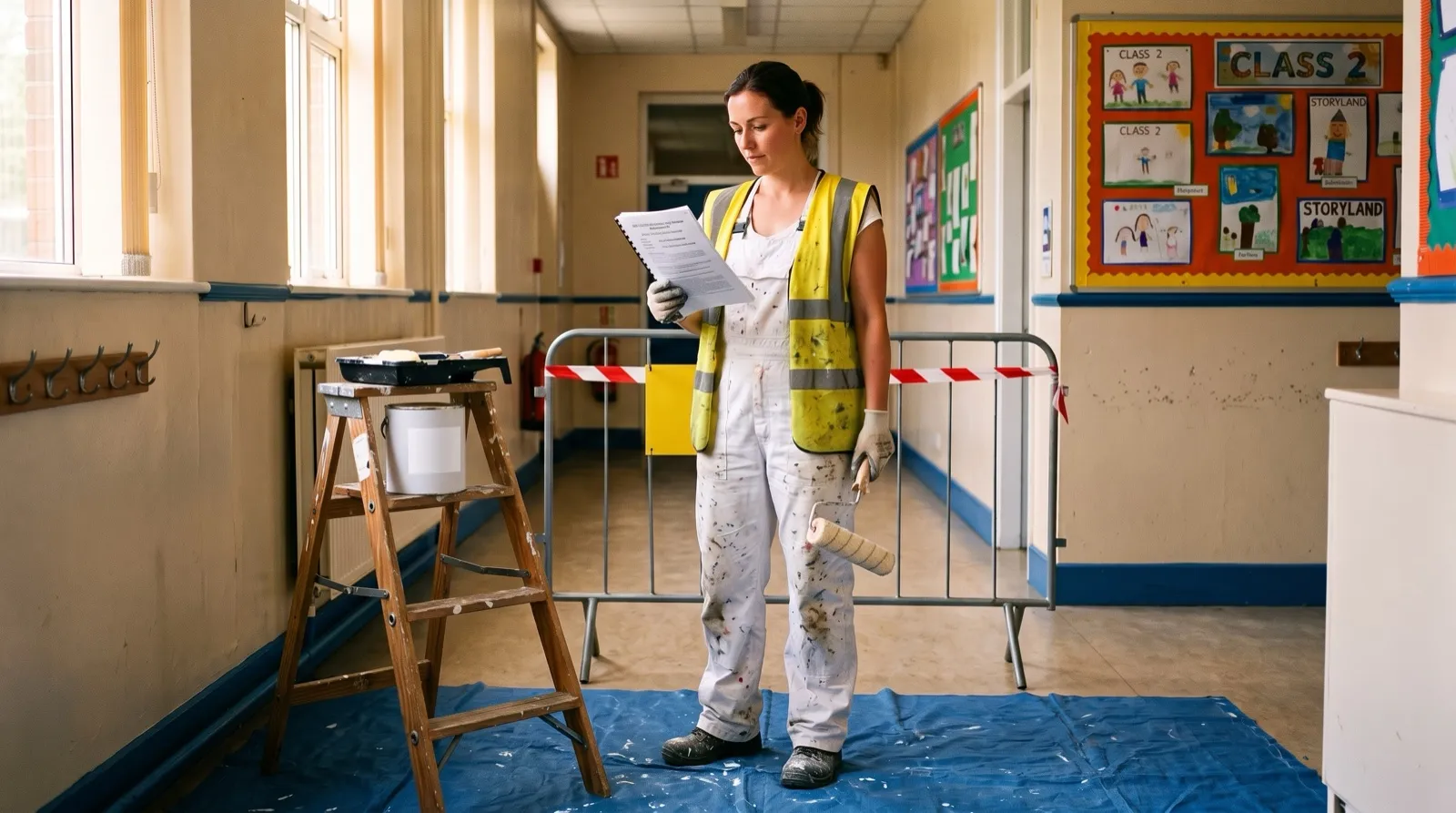
A two-person decorating firm repainting a primary school corridor over the half-term week. The building is closed to pupils but the caretaker and office staff are in. This is what the pack covers, in outline. The detail on your own job comes from your own walk round.
Risk Assessment, in Summary
- Working from steps and a podium. Falls while cutting in at height. Podium steps preferred to ladders, footing checked, no overreaching, tools in a belt not a hand.
- Staff walking through the work area. Slips on dust sheets, contact with wet paint and tools. Corridor closed with a barrier and a sign at both ends, alternative route agreed with the caretaker, reopened only after the hold point in the sequence.
- Old paint on a pre-1970s building. Possible lead in existing coatings. Test before sanding. If lead is present, wet methods and no dry sanding, and the control moves into a specific procedure.
- Solvent-based undercoat. Vapour in a corridor with limited ventilation. Water-based products used wherever the specification allows, windows open, COSHH assessment attached for the solvent product that remains.
- Storage of flammables overnight. Fire. Products stored in the van, not the building, and quantities on site kept to a day's use.
- Working in a school. Safeguarding. Staff informed of who is on site, decorators signed in and out, no unsupervised access to areas outside the corridor.
Method Statement, in Summary
- Arrive, sign in, induction with the caretaker: fire arrangements, welfare, the areas in use by staff. Hold point: corridor closure and alternative route confirmed before any sheet goes down.
- Close the corridor at both ends, signage up, dust sheets laid and taped at the edges.
- Paint test on existing coatings. Hold point: no preparation starts until the result is known and the method for any lead paint is agreed.
- Preparation: fill, sand with extraction, wipe down. Windows open throughout.
- Undercoat and topcoats, working from the far end back towards the exit, wet-edge times respected.
- End of each day: products back to the van, sheets folded, barrier checked, sign out.
- Final day: snag, clean, remove sheets and barriers. Hold point: caretaker walks the corridor with the supervisor before it reopens to staff.
Every hazard the risk assessment scores High has become a hold point in the sequence. That single feature is what separates a pack that gets accepted from one that gets sent back.
Why RAMS Get Rejected
Almost always for one of a small number of reasons, and every one of them is avoidable:
- It is generic. No address, no names, no dates, hazards that belong to a different trade.
- There is no sequence. The method statement reads as a list of things you will be careful about, not a set of steps in order.
- There are no hold points. Nothing ever stops for a check, so nothing in the pack can actually prevent anything.
- The two halves do not match. The assessment scores a hazard High and the method statement never mentions it.
- PPE is the only control. Gloves and glasses answer a different question from the one the reviewer is asking.
- Competence is missing. No names, no roles, no cards, so the reviewer cannot tell whether the people match the work.
- The emergency section is boilerplate. "Call 999" is not a rescue plan for a person suspended in a harness.
- It is out of date. Last year's version, an old address, a supervisor who has left. Reviewers check the date before anything else.
- Nobody has signed it. No author, no approval, no briefing record.
RAMS Checklist Before You Send It
- Site address, client, dates and the supervisor's name and number on the front page.
- Scope stated, exclusions stated.
- Every hazard names who is at risk and how.
- Controls in hierarchy order, with PPE last.
- Scores before and after controls, and every High risk carried into the sequence.
- Numbered sequence from arrival to handover, with hold points that say what is checked and by whom.
- People named, roles stated, competence evidenced.
- Plant and equipment listed with inspection arrangements.
- COSHH assessment attached for any hazardous substance, including dust and fume the work creates.
- Emergency arrangements specific to this site and this job.
- Author, approver, version, date, and a briefing register with room to sign.
- Read once more as the reviewer: could a stranger do this job safely from these pages alone?
Write It for the Person Reading It
A RAMS pack is a conversation with someone who has never met you and will decide in ten minutes whether you start on Monday. Give them the site, the people, the hazards as they really are, the sequence with its hold points, and a signature. If you are starting with the risk assessment, our step-by-step guide takes it from the walk round to the scored document.
Frequently asked questions
What does RAMS stand for?
Risk assessment and method statement. It is one pack made of two documents: the risk assessment sets out what could go wrong and the controls, and the method statement sets out how the work will be done, in order, with those controls built in.
Are RAMS a legal requirement?
The risk assessment is, under regulation 3 of the Management of Health and Safety at Work Regulations 1999. No regulation names a method statement, but CDM 2015 requires every contractor to plan, manage and monitor their work, and the method statement is the accepted way to show that. On any site with a principal contractor, or in an occupied building with a facilities manager, you will not be allowed to start without both.
Do I need RAMS as a sole trader?
You need a risk assessment, because regulation 3(2) applies the duty to every self-employed person. You need a method statement whenever the work is higher risk or whenever the client or principal contractor asks for RAMS. Most sole traders working for main contractors or in occupied buildings need both for every job.
Who should write RAMS?
The competent person who knows the job, which on most trade jobs is the tradesperson or supervisor leading the work. A consultant can help with unusual or high-risk work, but responsibility stays with the person who signs and runs the sequence.
How long should a RAMS document be?
As long as the risk needs. Four to six pages covers most trade jobs. High-risk work such as structural steel, excavation or confined spaces runs longer because the sequence has more steps and more hold points. Length that comes from padding rather than risk is skimmed past by reviewers and helps nobody.
What is the difference between RAMS and a construction phase plan?
The construction phase plan is the document CDM 2015 requires for the project as a whole: how the whole site will be organised and managed, held by the principal contractor or by the sole contractor. RAMS are written by each contractor for their own work package. The principal contractor checks each RAMS against the plan.
How often should RAMS be updated?
For every new site, because a RAMS pack is site-specific by definition. Within a job, whenever the method, the people, the equipment or the site changes, or after an incident or near miss. Give every version a number and a date so the reviewer can see it is current.
Do I need RAMS for events work?
Yes, in practice. Venues and production companies ask for RAMS before any build, rigging or de-rig, and the same structure applies: hazards and controls in the assessment, the sequence with hold points in the method statement. Exclusion zones, truss and rigging checks, and working around the public are the lines reviewers look for first.