
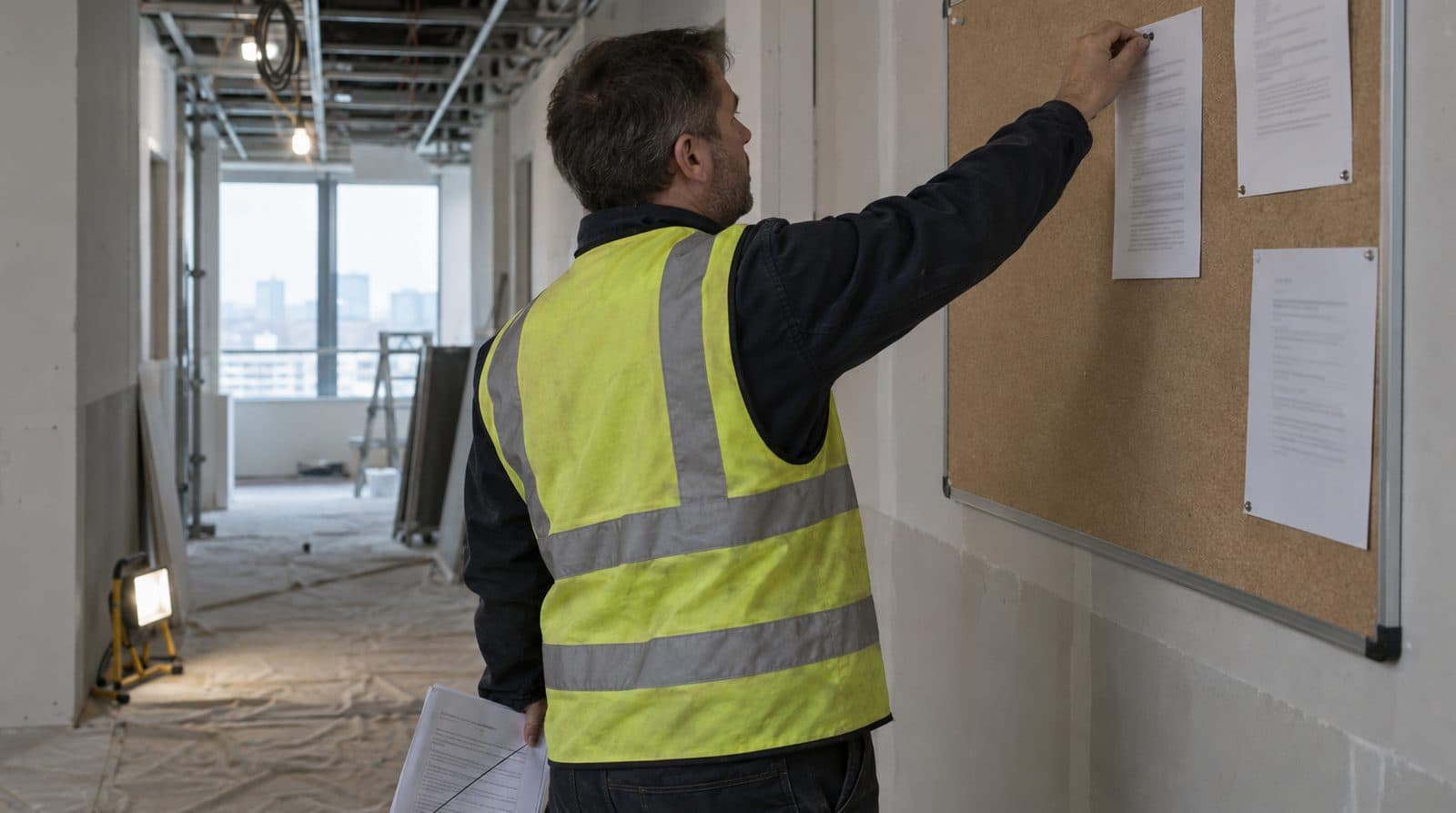
There is no fixed legal interval for how often RAMS should be reviewed. The law requires the risk assessment to be reviewed when there is reason to suspect it is no longer valid, or when there has been a significant change. In practice that means a review before every new job or site, whenever something changes during the job, and after anything goes wrong or nearly does. A review date on the front sheet catches whatever those miss.
Review in general, the last of HSE's five steps, is covered in how to write a risk assessment, and the check on the day is a dynamic risk assessment. This guide covers the RAMS themselves: when they need updating, how to revise and number them, and how to brief the change.
What the Law Says About Reviewing RAMS
The risk assessment. Regulation 3(3) of the Management of Health and Safety at Work Regulations 1999 is the review duty. The assessment "shall be reviewed by the employer or relevant self-employed person who made it" if "there is reason to suspect that it is no longer valid" or "there has been a significant change in the matters to which it relates". Where the review shows changes are required, whoever made the assessment "shall make them".
A relevant self-employed person is one whose work is in construction or could put others at risk. Employers with five or more employees must record the significant findings, so a changed assessment means a changed record.
The method statement. The law does not require a method statement for most work. For demolition or dismantling, CDM 2015 requires the arrangements to be recorded in writing before the work begins, and HSE says this is usually done with a method statement. HSE's construction guidance also says when one should change: "If a similar operation is repeated, the statement will be similar from job to job. However, if circumstances change markedly e.g. with demolition, the statement should be revised for each job." The method statement is built from the risk assessment, so a changed control in one has to reach the steps in the other.
The 1999 Regulations apply in Great Britain. Northern Ireland's regulations carry the same review triggers.
How Often Should RAMS Be Reviewed?
As often as there is a reason to, and no later than the review date on the front sheet. No regulation sets an interval. HSE says so in the guidance for its manual handling assessment tool: "There is no legal time frame for when you should review your risk assessment." It adds: "As a guide, it is recommended that risk assessments be reviewed on an annual basis."
Treat a date as a backstop. RAMS that stay in use, for term maintenance, a long job or repeat work for one client, should carry a next review date. HSE's yearly guide is a sensible longest gap. Work that changes often, or carries higher risk, deserves a shorter one. If the client or principal contractor sets a review period, work to theirs.
A date never replaces a trigger. RAMS reviewed last month are out of date today if the method changed this morning.
The Changes That Mean RAMS Need Updating
HSE's guidance on managing risk says you "must review the controls you have put in place to make sure they are working". It names "changes in the workplace that could lead to new risks", such as changes to staff, a process, or "the substances or equipment used". And it adds: "Also consider a review if your workers have spotted any problems or there have been any accidents or near misses."
On a trade job, these are the triggers.
| Trigger | Why it counts | What to check |
|---|---|---|
| A new job or site | The RAMS were written for another place and other people. | Site details, access, occupants, emergency arrangements, every hazard line. |
| A change of method or sequence | The controls were built into the old order of work. | The steps, the hold points (planned checks before work carries on) and the risk assessment lines behind them. |
| New equipment, plant or substances | New kit brings its own hazards and training. | Equipment lines, training, any COSHH assessment. |
| Different people | A new starter, a subcontractor or a lone worker changes who is at risk. | Who could be harmed, supervision, competence. |
| A worker under 18 | Regulation 3(4): an employer must have "made or reviewed" the assessment for young persons before employing one. | Supervision, and the tasks they will not do. |
| An accident, near miss or a problem the crew spots | A control may not be working. | The line it happened under, and whether the control was wrong or not followed. |
| Site conditions change on the day | The job is not the one on paper. | What the check found. See getting it back into the written assessment. |
| The site rules or construction phase plan change | Where there is more than one contractor, regulation 15(3) of CDM 2015 requires each to follow the parts of the plan relevant to their work. | Permits, working hours, access, site rules. |
Significant change. The regulations do not define it. A rule of thumb, not a legal test: a change is significant if it alters a hazard, who could be harmed, a control or the order of work. A new delivery day is not. A different access route is.
Revise and Re-Issue, or Write New RAMS?
A review ends in one of three ways.
No change needed. Note on the front sheet that the review happened, when, by whom and why. Without that note, reviewed RAMS look the same as RAMS nobody read. If a client asks when your RAMS were last reviewed, this note is the answer: give them the date and the revision.
Revise and re-issue. Same job, same site, and the change touches some lines. Rewrite and re-score the risk assessment lines it affects. Carry the change into the method statement: the steps, the hold points and who checks them. Then check the two against each other and issue the pair as a new revision.
Write new RAMS. A different job, a different site, or a change so large that most lines would be rewritten. For similar work, start from the last RAMS, but walk the new site and write the site-specific parts from what you find. Changing the address on last month's pack is not a review.
Revision Numbers, Dates and the Old Version
No regulation sets a format. This is common practice, and it shows which version is current, one of the things clients and principal contractors check.
- Revision number. Number every issued change, and put the same number on both documents so the pair can be matched.
- Date and reviewer. When the revision was issued, who reviewed it, and the next review date or trigger.
- What changed. One line per revision on the front sheet. For example: "Revision 2: exclusion zone widened, hold point added before the platform is raised, after a near miss."
- The old version. Mark it superseded and take printed copies off site. Keep it on file, because it shows what was in force on a given day. The regulations above do not say for how long.
- Who holds a copy. Send the new revision to everyone who had the old one: principal contractor, client, facilities manager. If they approved the old one, they may want to see the new one before work carries on.
Re-Briefing the People Doing the Work

Revised RAMS change nothing on site until the crew knows what changed.
Regulation 10 requires every employer to give employees "comprehensible and relevant information" on the risks identified by the assessment and "the preventive and protective measures". Under regulation 13, employers must train employees exposed to "new or increased risks", including from new equipment or a changed system of work, and adapt that training "to take account of any new or changed risks". On construction work, regulation 15(8) of CDM 2015 requires contractors to give their workers "appropriate supervision, instructions and information".
How to brief a revision:
- Before work carries on. Brief the crew where the work is, before the changed task restarts.
- The change, not the whole pack. What changed, why, and what each person now does differently. If the change is large, go through the whole pack.
- Check it landed. Ask someone to talk you through the changed step.
- Record it. Names, date and revision number on the briefing sheet. No regulation requires a signature, but a signed sheet is the usual way to show the briefing happened, and principal contractors often ask for one. Anyone who joins later is briefed on the current revision before they start.
If you work alone, tell the people your change affects instead: the site manager, other trades nearby, the householder.
Example: A Fit-Out Moving to a New Unit
An example, not a real case. A fit-out firm of four, the owner and three operatives, fits ceilings and partitions in shop units for one retail client. Each unit gets its own RAMS. The last unit was at street level, worked by day from mobile towers.
The next unit is on the first floor of a shopping centre, worked at night under the centre's site rules. The ceiling is higher, so the client wants a mobile elevating work platform instead of towers. And a 17-year-old apprentice joins the firm.
| What changed | Trigger | What changed in the RAMS |
|---|---|---|
| First floor, shared goods lift, centre site rules, night working | New site, new site rules | New RAMS, started from the last unit's. Access, deliveries, emergency arrangements and hours written from the site visit. Revision 1. |
| A mobile elevating work platform instead of towers | New equipment | New lines: operated only by people trained on it, checked before use, the floor's loading confirmed by the centre, and a plan for rescue from the platform. Hold point before first use. |
| A 17-year-old apprentice | A young person | Assessment reviewed before the start date. The Working Time Regulations 1998 bar young workers from night work on a job like this, so the apprentice starts on the next day-time unit, under the owner's direct supervision. |
| Second night: an offcut of ceiling grid falls from the platform, just outside the barrier, as a security guard walks past | Near miss | Exclusion zone widened. Offcuts go straight into a tray on the platform. New hold point: the platform is not raised until the zone is checked closed. Revision 2. |
Revision 2 went out before the next shift. The owner briefed the crew on the three changes at the start of the night, and each signed the briefing sheet against revision 2. Revision 1 came off site, marked superseded, and the centre's management got revision 2 with a line on what had changed.
Checklist Before Revised RAMS Go Back Into Use
- The trigger is written down: what changed, and when.
- The risk assessment lines it affects are rewritten and re-scored, and the method statement steps behind them updated.
- Both documents show the same site, people, equipment and revision number.
- The front sheet shows the revision, date, reviewer, what changed and the next review date.
- The old version is marked superseded, off site and on file.
- Whoever holds a copy has the new revision.
- Everyone doing the work has been briefed on the change before carrying on, and the briefing is recorded.
If the change is big enough that you need new RAMS, Safetyfox writes the risk assessment or the method statement from your answers to a short set of plain questions about the job, one document at a time, for you to read and change before you use it.
Frequently asked questions
Do RAMS expire?
No regulation gives RAMS an expiry date. The law requires the risk assessment to be reviewed when there is reason to suspect it is no longer valid, or after a significant change. RAMS stay usable while they still match the job, the site and the people. If a client sets its own review period, work to it.
Should RAMS be reviewed every year?
No law requires a yearly review. In the guidance for its manual handling assessment tool, HSE says there is no legal time frame for reviewing a risk assessment, and recommends a yearly review as a guide. For RAMS that stay in use, a yearly date is a backstop, never a substitute for reviewing when the job changes.
Can I use the same RAMS for every job?
Only as a starting point. HSE says a method statement for a repeated operation will be similar from job to job, but should be revised for each job when circumstances change markedly. The site, people, access and emergency arrangements nearly always differ, so walk the new site and rewrite what is different first.
Who should review RAMS?
The law puts the review of the risk assessment on the employer, or the relevant self-employed person, who made it. In practice that is whoever knows the job, usually the owner or supervisor who wrote it, with input from the people doing the work. An employee who spots a problem should report it.
Do workers need to sign RAMS again after an update?
No regulation requires a signature. Employers must give employees information on the risks and controls, and training adapted to new or changed risks. A briefing on what changed, recorded with names, the date and the revision number, is the usual way to show it happened. Principal contractors often ask to see that record.
What counts as a significant change?
The regulations do not define it. As a rule of thumb, a change is significant if it alters a hazard, who could be harmed, a control or the order of work. A new site, a new method, new equipment, a new or young worker, and an accident, incident or near miss all call for a review.